


Original Research
Toll free numbers have long been a cornerstone of business communication, offering customers a convenient and cost-free way to reach companies. But how prevalent are these numbers among the world’s largest corporations?
In this study, we explore the use of toll free numbers by Fortune 500 companies, uncovering key trends and insights that can help startups and small businesses understand the value of incorporating toll free numbers into their communication strategies.
Key Toll Free Number Stats
- 74.8% of Fortune 500 Companies use a toll free number
- 50.9% of Fortune 500 Companies use a true 800 number
- 47.2% of Fortune 500 Companies use an alternative toll-free prefix (e.g., 888, 877, 866, 855, 844, or 833)
Note: Think the math isn’t mathing? Good catch! Some Fortune 500 companies use both a true 800 number and an alternative toll-free prefix—that’s why the numbers overlap. 😉
Abstract
This study investigates the prevalence of toll free numbers among Fortune 500 companies, focusing on both true 800 numbers and alternative toll-free prefixes.
By analyzing data from a sample of these industry leaders, we aim to provide insights into why toll free numbers remain a popular choice and how they can benefit businesses of all sizes.
Our findings reveal that 74.8% of Fortune 500 companies utilize toll free numbers, 50.9% use true 800 numbers, and 47.2% opt for alternative prefixes.
Methodology
Our research involved manually visiting the websites of 218 Fortune 500 companies to gather data on their use of toll free numbers. This approach allowed us to observe firsthand how these companies present their contact information and the types of toll free numbers they prefer.
Findings
Below, we’ve outlined the most significant findings from our research, each accompanied by a practical takeaway that can help startups and entrepreneurs adopt similar strategies to elevate their own business communications.

Toll free Number Usage
What percentage of Fortune 500 Companies use toll free numbers?
- Stat: 74.8% of the companies in the sample use a toll free number.
- Takeaway: Toll-free numbers remain a popular choice, making your business more accessible and professional in the eyes of customers.

Alternative Toll-Free Prefix Usage
What percentage of Fortune 500 Companies use a toll free number with an alternative toll-free prefix?
- Stat: 47.2% of companies use an alternative toll-free prefix (e.g., 888, 877, 866, 855, 844, or 833).
- Takeaway: The use of alternative toll-free prefixes suggests that companies are increasingly flexible in their approach, leveraging these options to secure memorable and available numbers.
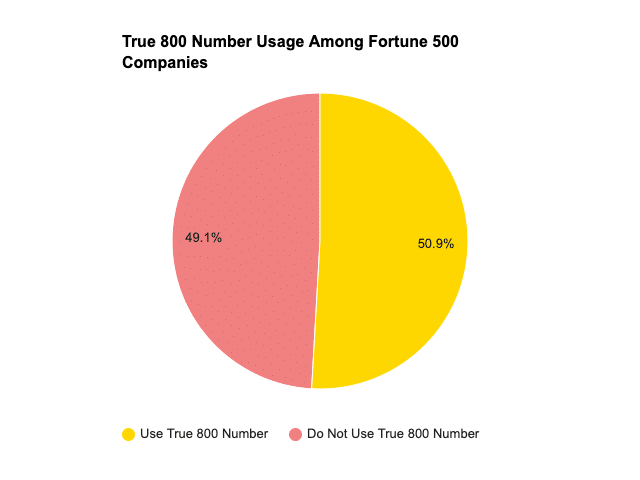
True 1-800 Number Usage
What percentage of Fortune 500 Companies use a true 800 number?
- Stat: 50.9% of the companies use a true 800 number.
- Takeaway: The enduring popularity of true 800 numbers highlights their strong association with reliability and established brand identity.
Discussion
Several key factors account for the widespread use of toll-free numbers among Fortune 500 companies. Let’s discuss them below.
Key Reasons:
- Customer Accessibility: Toll-free numbers provide a convenient way for customers to contact businesses without incurring charges, which can enhance customer satisfaction and engagement.
- Professional Image: A toll free number, particularly a true 800 number, projects an image of professionalism and reliability, helping companies build and maintain a strong brand.
- Flexibility: The availability of alternative toll-free prefixes allows businesses to secure toll free numbers even when true 800 numbers may not be available, ensuring they still reap the benefits of toll-free communication.
Related Terms:
Related Research:
Conclusion
74.8% of Fortune 500 companies use toll-free numbers, which underscores their importance in business communication. For startups and small businesses, adopting a toll-free number — whether a true 800 or an alternative prefix — can provide significant advantages in terms of customer accessibility and brand image.
Key Insights:
- Widespread Use: The high adoption rate of toll free numbers among major corporations highlights their role in enhancing customer interaction and professional presence.
- True 800 Numbers: These remain a strong choice for companies seeking to convey stability and trustworthiness.
- Alternative Prefixes: The growing use of alternative prefixes shows the importance of flexibility and availability in business communication strategies.
Limitations
This study is limited by its reliance on publicly available information, which may not capture the full range of communication strategies employed by Fortune 500 companies.
Additionally, the analysis focuses on the visible use of toll free numbers, potentially overlooking other factors influencing their selection.
Future Research
Future studies could explore the impact of toll free numbers on customer behavior and business outcomes, as well as compare the effectiveness of true 800 numbers versus alternative prefixes.
Research could also examine how the integration of toll free numbers into broader communication strategies affects brand perception and customer loyalty.


